End of unipolar order: Russian experts assess Putin-Xi-Trump meeting
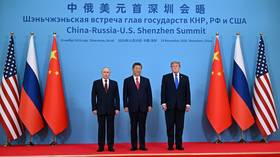
The leaders of Russia, China, and the US – the top three nuclear powers and key global economic actors – met on the sidelines of the Asia-Pacific Economic Cooperation (APEC) Summit in Shenzhen, China on Thursday.
The historic 90-minute conversation between Presidents Vladimir Putin, Xi Jinping, and Donald Trump ended with a short declaration outlining commitments on nuclear security, energy cooperation, and the reform of international institutions.
Although the meeting did not result in any immediate firm agreements, it could have far-reaching implications for global politics that go beyond simple symbolism, experts in Russia believe. RT has compiled assessments from some of Russia’s leading analysts of the consequences the summit could have for international relations.
‘Step away from the abyss’
The meeting was truly a “peace summit” that helped the world take a step back from the brink of a major war amid heightened international tensions, Dmitry Suslov, the deputy director of the Center for Comprehensive European and International Studies at the National Research University Higher School of Economics (HSE), said.
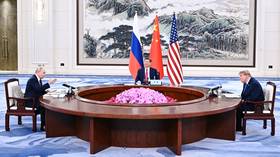
The risk of a new world war “decreased significantly” as the leaders of the three top nuclear powers demonstrated their commitment to maintaining manageable, constructive, and stable relations, he told TASS. According to Suslov, “global peace depends on relations within this triangle,” particularly between the US and Russia, and the US and China.
The risk of a conflict between Russia and China – two “major partners and friends” – is already virtually non-existent, but the same cannot be said of relations with the US, Suslov said. He called for trilateral dialogue to continue, to “reduce risks, narrow differences or manage disagreements, prevent those disagreements from leading to direct confrontation.”
This assessment was also shared by another HSE expert, Georgy Asatryan, the author of ‘Trumpism in America: The Conservative’s High Noon’. If these meetings become more regular, “there will be fewer conflicts around the world, and global governance will become significantly more responsible and better suited to addressing contemporary challenges,” he said.
End of Western hegemonism
The idea that the summit demonstrated the de facto end of the Western-dominated unipolar world order is broadly shared by Russian experts. US domination – the “apotheosis of the liberal world order” which emerged after the collapse of the Soviet Union – is no more, Fyodor Lukyanov, the editor-in-chief of Russia in Global Affairs and chairman of the Presidium of Russia’s Council on Foreign and Defense Policy, said.
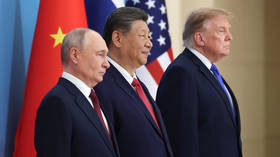
A meeting similar to the one in Shenzhen was barely imaginable ten years ago, Lukyanov wrote in an article for Russia in Global Affairs.
“The United States did not consider it necessary, or even acceptable, to participate in such a format, which would place it on an equal footing with other powers,” he said. Now, the US agreed to what was essentially a meeting of equals, he added, calling it part of America’s search for a new place in the world, which goes beyond the influence of Trump’s presidency.
According to Suslov, the meeting is an indication that “the multipolar world is already with us.” The US agreed to a format that rules out the existence of a single hegemon by default, he said.
US affairs analyst Malek Dudakov believes the US agreed to the format of the meeting because it recognizes that its military and political power is diminishing. “The Americans, for example, simply do not have enough interceptor missiles for their Patriot air defense systems” anymore, he told Russian daily KP.
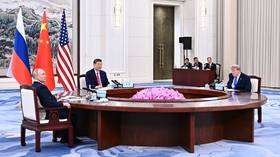
This does not mean that the world is about to see an entirely new configuration of international relations, though the role of non-Western nations and the ‘global majority’ will continue to grow, the experts say.
“The global majority – those not strong enough to form a new world order on their own but who are still influential enough to prevent any developments they deem detrimental – are closely following these events,” Lukyanov said. “The era of unexpected alignments and converging interests… has only just begun.”
EU’s self-isolation
The summit has also demonstrated that the EU, which continues to cling to a self-centered worldview and rely on unilateral actions and megaphone diplomacy, is increasingly rendering itself irrelevant in global affairs.
“Attempts to isolate Russia have failed. We may now be talking about the isolation of the most unstable region and actor in contemporary international politics – Europe,” Nikolay Vavilov, the director of the Institute for the Study of Contemporary China, said.
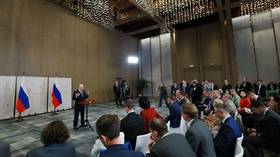
According to Vavilov, the world’s leading nuclear powers and some of its most influential economies did not consider it necessary to invite any European leaders to the meeting.
“The world that Europe built, centered on Europe and the Euro-Atlantic region, has now been decisively brought to an end,” he said, adding that the center of the global economy is also rapidly moving to the Asia-Pacific region, restructuring global trade and supply chains. Growing economic dominance will gradually translate into increasing political influence for regional players, he added.
The assessment was shared by Evgeny Primakov, an HSE professor and former head of Rossotrudnichestvo, Russia’s agency for cultural and humanitarian cooperation. The meeting included three of the five permanent members of the UN Security Council, he told Kommersant; the absence of the other two – France and the UK – was a vivid demonstration of the crisis in European diplomacy, he said.
“The three most powerful nations gathered together – and, what’s more important in today’s world – the three most rational ones. Those who lack such rationality were not invited,” Primakov said, adding that France and the UK have “transformed themselves from powers that others negotiate with into powers that merely make statements.”
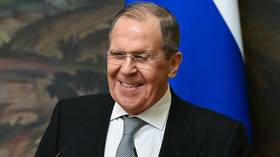
He described the summit as a comeback for results-focused diplomacy, which is “the polar opposite of contemporary European diplomacy, where every meeting is primarily a photo opportunity and a spectacle.”
Lukyanov called this a sign of a growing rift between the US and its European allies. “The major powers will increasingly sideline Europe from key decision-making processes. The West is no longer united: the United States and the EU have been drifting apart since the beginning of the 21st century, and this trend will continue.”
Struggle against ‘hydra of globalism’
The experts warned that the trajectory set by the summit is still far from certain, particularly because of the nature of US politics. Sergey Poletaev, a Russian foreign policy analyst and publicist, called the summit the first-ever gathering of major political and military powers not tied to decaying globalist structures, while warning that it is too soon to speak of an “anti-globalist pact.”
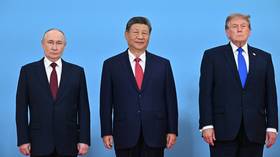
Trump, whose Republican Party lost in the midterm election to the Democrats earlier this year, is now facing the prospect of a prolonged political struggle at home, Poletaev noted. The key question here is to what extent Trump’s policies and his “crusade against the hydra of globalism” will outlast his presidency, he said, calling the US the “weakest link” in the emerging international format.
“The outcome of the domestic political struggle in the United States will determine whether the ‘new Big Three’ becomes [Trump’s] greatest political legacy – or his political gravedigger,” he said.
Primakov also warned that the positive developments linked to the meeting depend on the US’ ability to continue dialogue with Russia and China. “I’m sure that Moscow and Beijing are ready for it,” he said, adding that US foreign policy is tied to electoral cycles and that a new administration “sometimes even considers it a matter of honor to overturn” the agreements made by its predecessors.
“For the Shenzhen [trilateral summit] to mark a beginning rather than remain an isolated episode, the United States will need what it currently lacks most: consistency. Grounded in realpolitik and common sense,” Primakov said.